
Regulatory and evidence
Certified assessment, trial-proven treatment — all in the open
4DEYE Dx is MFDS Class II certified and in clinical use. 4DEYE DTx has completed an MFDS-approved confirmatory trial and is preparing for marketing authorization.
- 4DEYE Dx
- Class II · non-covered service
- 4DEYE DTx
- Trial completed · preparing for marketing authorization
- Quality
- GMP · ISO 13485
- Papers
- 6 SCI papers
1 · Regulatory pathway
Dx is certified; DTx is preparing for marketing authorization
Two products, two routes. Dx measures, so it needed certification. DTx treats, so it had to prove efficacy in a confirmatory trial first.
4DEYE Dx
AI musculoskeletal assessment · medical device
A Class II device measuring joint angles and movement, reviewed for performance, safety and manufacturing quality.
Measurement validity
Accuracy and repeatability against VICON, shown in five SCI papers.
GMP conformity
2024Design, manufacturing and release audited against medical device GMP.
Technical review · Class II certification
2024After review of intended use, performance, safety and software verification, NIDS (for the MFDS) certified it as Class II. ISO 13485 followed a year later.
Non-covered billing · in clinical use
Billable as a non-covered motion analysis service (code EZ774). In use at 26 sites, including hospitals and clinics.
4DEYE DTx
Digital therapeutic for knee pain
A therapeutic must prove efficacy in a trial before marketing authorization. We have completed that confirmatory trial — the equivalent of a drug’s phase 3.
GMP conformity
2024Software development, verification and maintenance audited as a medical device.
Trial plan approval (IDE)
2025As a Class II software device, its eligibility, primary endpoint, sample size and analysis plan were approved by the MFDS.
Confirmatory trial completed
2026Prof. Lee Byung-hoon’s team, Orthopaedic Surgery, Gachon University Gil Medical Center · assessor-blinded RCT · 151 participants · 12 weeks. Primary endpoint (KOOS-12) improved significantly vs. home exercise.
Preparing for marketing authorization
Assembling the study report, technical file, and software verification and cybersecurity data for MFDS review.
nHTA · health insurance coverage
After authorization, a new health technology assessment and a coverage decision precede clinical prescribing.
After marketing authorization come a new health technology assessment and a National Health Insurance coverage decision. Routes and timelines vary.
2 · Certificates
Confirmed by regulators and auditors

Class II medical device certification
4DEYE Dx · certified 2024 · billable
NIDS, on behalf of the MFDS


GMP conformity (Dx and DTx)
Separate certificates: measurement device (Dx), software medical device (DTx)
MFDS GMP audit body

ISO 13485 quality management system
Design, development and production of mobility test equipment · 2025
Kiwa Korea (IAF, KAB accredited)

MFDS confirmatory trial approval (IDE)
4DEYE DTx · chronic knee pain trial · approved 2025
Ministry of Food and Drug Safety

Regulatory sandbox special exemption confirmation
Issued 2026
Ministry of Trade, Industry and Resources

Rapid confirmation of new technology, R&D Special Zone
Issued 2025
Ministry of Science and ICT
3 · Patents
Protected by patents
Movement impairment assessment, disease risk prediction, personalized prescription — each stage of our core technology is patented.
01
Movement impairment assessment
Hardware patent · Software patent
A five-camera sensing structure that reads a joint’s 3D path, and an algorithm that detects compensation in that data.
02
Disease prediction
Software patent
A method that calculates risk from measured functional decline, inferring which muscles are overactive or weakened.
03
Personalized prescription
Software patent
A method that builds corrective exercise from results, then recognizes performance accuracy and gives feedback.
Hardware patent
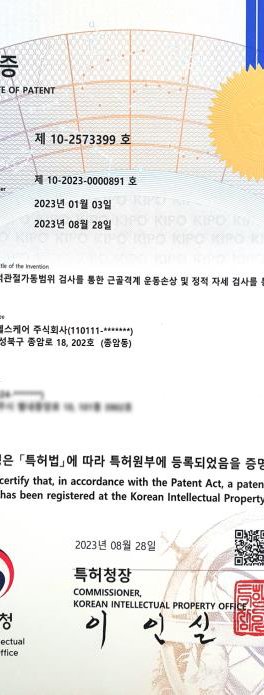
Software patent

Software patent

Software patent

Registered design

Japan patent

2 software applications

2 PCT applications

Rights at a glance
- Registered patents (Korea)
- 4
- Registered patent (Japan)
- 1
- Registered design
- 1
- Applications filed (Korea)
- 2
- PCT international applications
- 2
- US · Europe
- Applications in progress
As of 2026 · US and EU applications pending
4 · Measurement
First, proof that it measures accurately
Compared head-to-head with VICON, the rehabilitation standard in optical motion capture.
Same motion, VICON vs. 4DEYE: how close are the values?
Agreement is measured as the intraclass correlation coefficient (ICC): 1.00 means identical values; near 0, they differ. ICC ≥ 0.75 is "good"; ≥ 0.90 is "excellent" (Koo & Li, 2016).
Poor0.5
Moderate0.75
Good0.9
Excellent
Concurrent validity
ICC 0.75–0.99
Hip, knee and trunk measured together · Applied Sciences 2024
Angle-trajectory validity
ICC 0.86–1.00
Sitting, standing and squats · Journal of Human Kinetics 2023
Test–retest reliability
ICC 0.68–0.99
Same motion, same value on retest · Sensors 2023 · JHK 2023
ICC near 1.00 means close agreement with VICON — not that a treatment works. We keep the two claims separate.
Prior study 1 · done
Single-joint reliability
Prior study 2 · done
Multi-joint reliability
Prior study 3 · done
Integrated-joint reliability
Pilot 4 · done
Digital content efficacy
Confirmatory trial · done
DTx safety and efficacy
Accuracy and repeatability — 4 papers
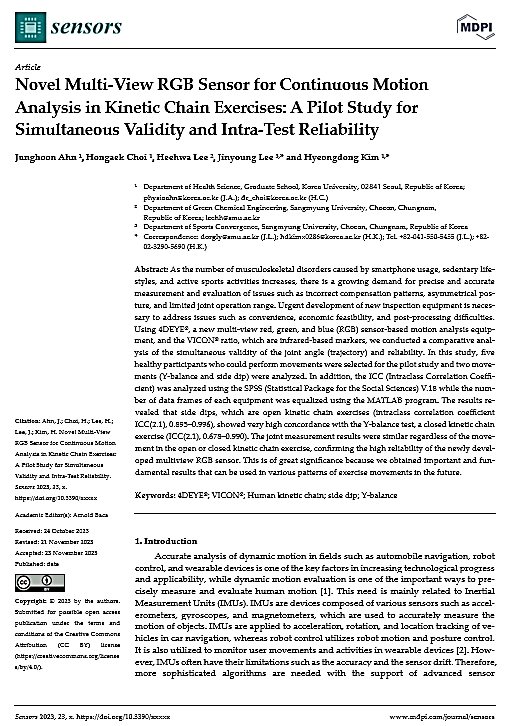 01
01Pilot study of reliability in dynamic balance movements
Sensors · Impact Factor 3.5
Y-balance and side-dip tests agreed with VICON at ICC 0.68–1.00.
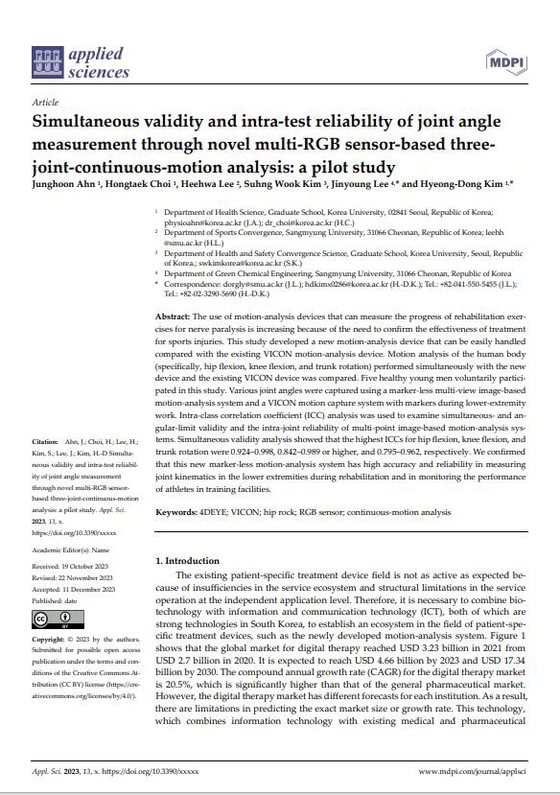 02
02Concurrent validity of three-joint measurement
Applied Sciences · Impact Factor 2.5
Measuring hip, knee and trunk together still held ICC 0.80–0.99 against VICON.
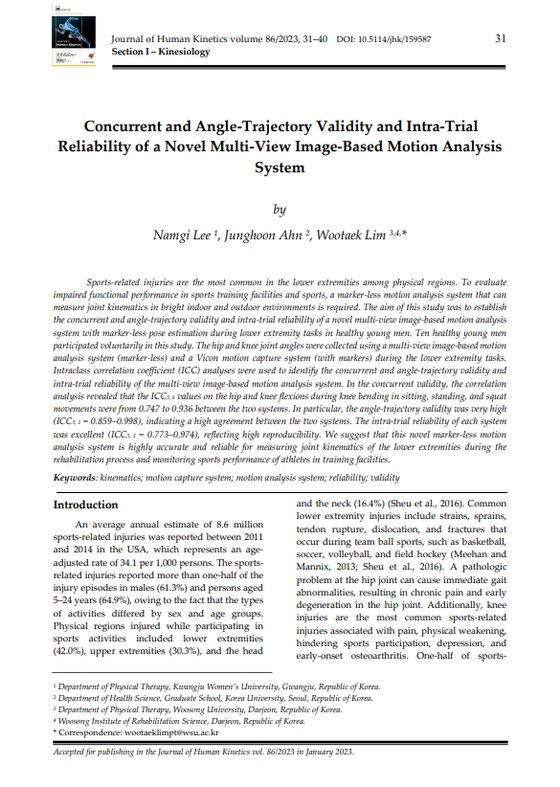 03
03Concurrent and angle-trajectory validity across the kinetic chain
Journal of Human Kinetics · Impact Factor 1.9
In sitting, standing and squats, validity, trajectory agreement and reliability all reached ICC ≥ 0.75.
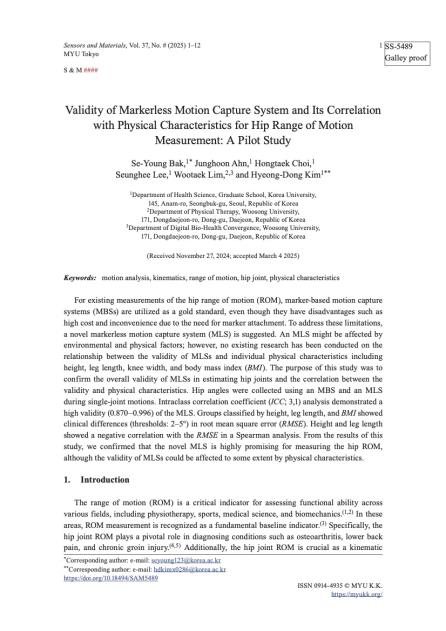 04
04Validity of markerless hip range-of-motion measurement
Sensors and Materials · Impact Factor 1.2
Hip range of motion measured without markers matched the conventional method.
During walking — 1 paper
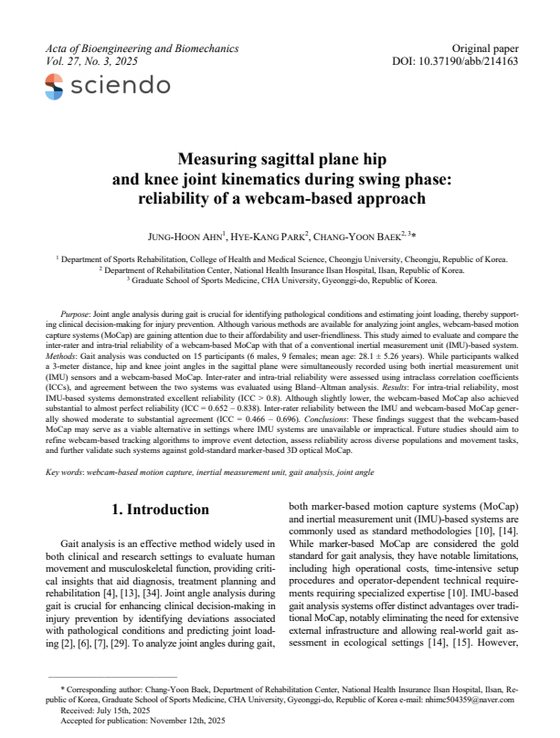 05
05Joint measurement reliability during gait
Acta of Bioengineering and Biomechanics · Impact Factor 1.0
Measurement reliability held during a specific phase of walking.
Treatment effect — 1 paper
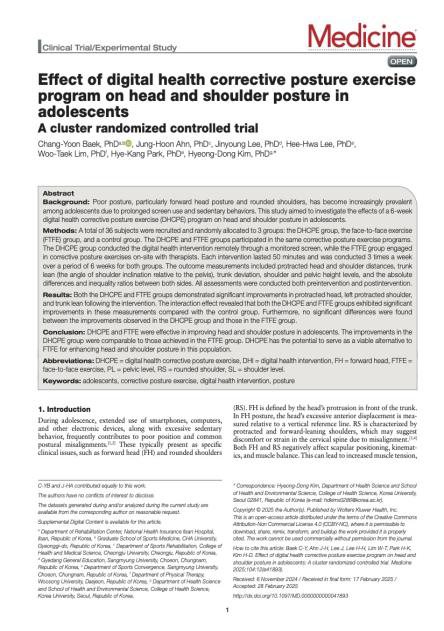 06
06Cluster randomised controlled trial of posture improvement with digital content
Medicine · Impact Factor 1.4
In 36 adolescents, digital exercise content alone improved posture about as much as in-person therapist coaching.
5 · Treatment
Knee pain DTx confirmatory trial
A prospective, assessor-blinded RCT of our own product — not a competitor’s data.
- Site
- Prof. Lee Byung-hoon’s team, Orthopaedic Surgery, Gachon University Gil Medical Center
- Design
- Single-centre · assessor-blinded · parallel-group · ITT
- Participants
- n=151 (78 vs 73)
- Duration
- 12 weeks · 3×/week
Improvement vs. control
KOOS-12 function scorePrimary endpoint
+5.24P < .001
Quality of life (physical)
+7.35
Knee flexion ROM
+3.08°
Adherence
81.4%vs 77.2%
Intervention-related adverse events
0
- IRB
- GCIRB2025-212
- Trial registration
- CRIS KCT0011905
- Current stage
- Trial completed · preparing for marketing authorization · under SCI journal review · low back pain trial under way
Clinical and public partners
Research in hospitals, results in the field


Prof. Lee Sang-heon’s team, Rehabilitation Medicine, Korea University Anam Hospital
Clinical site 1 · PI, non-specific low back pain DTx trial under way
Photo: Korea University Medicine PR Manager, CC BY-SA 4.0, Wikimedia Commons
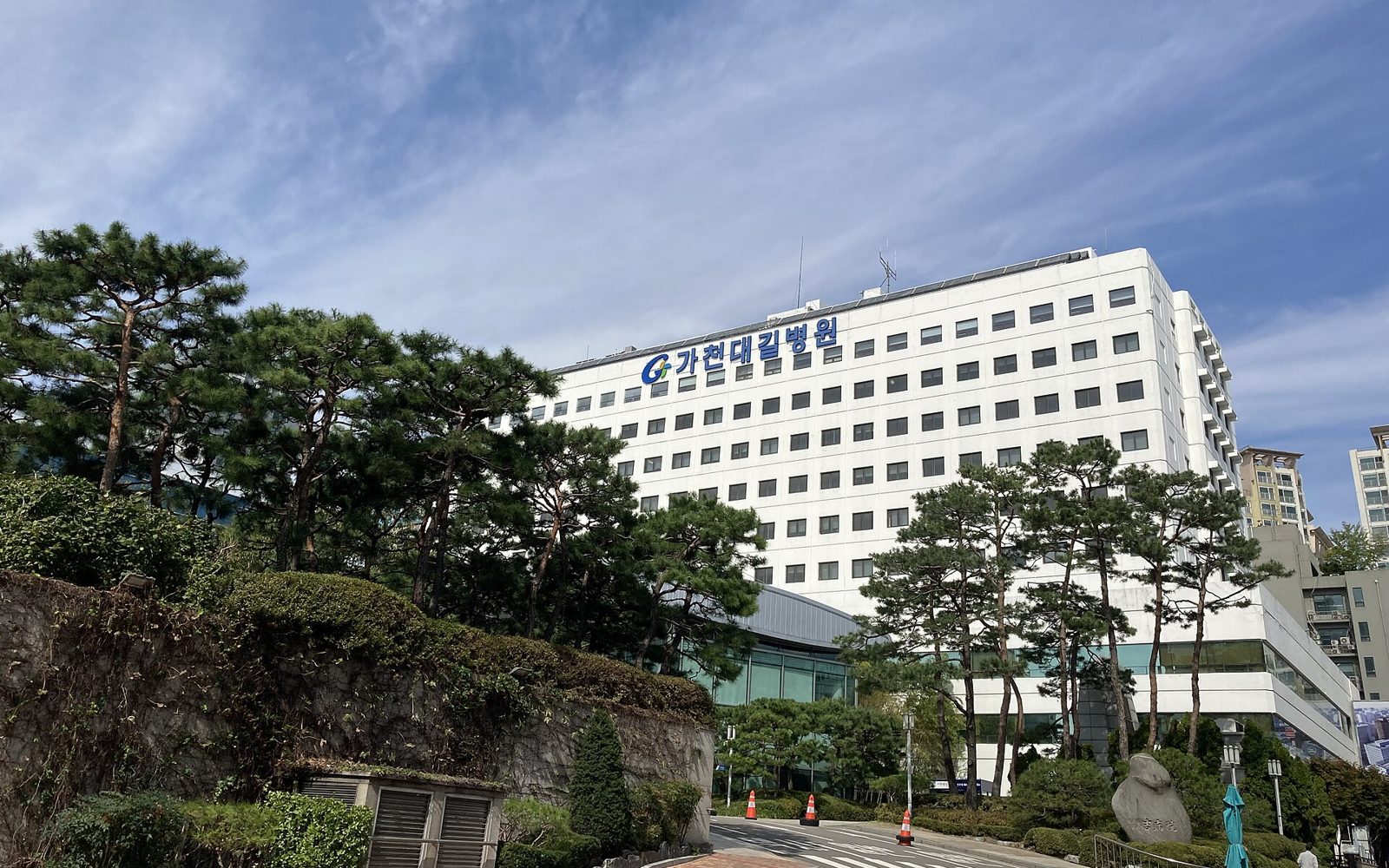

Prof. Lee Byung-hoon’s team, Orthopaedic Surgery, Gachon University Gil Medical Center
Clinical site 2 · PI, chronic knee pain DTx trial completed
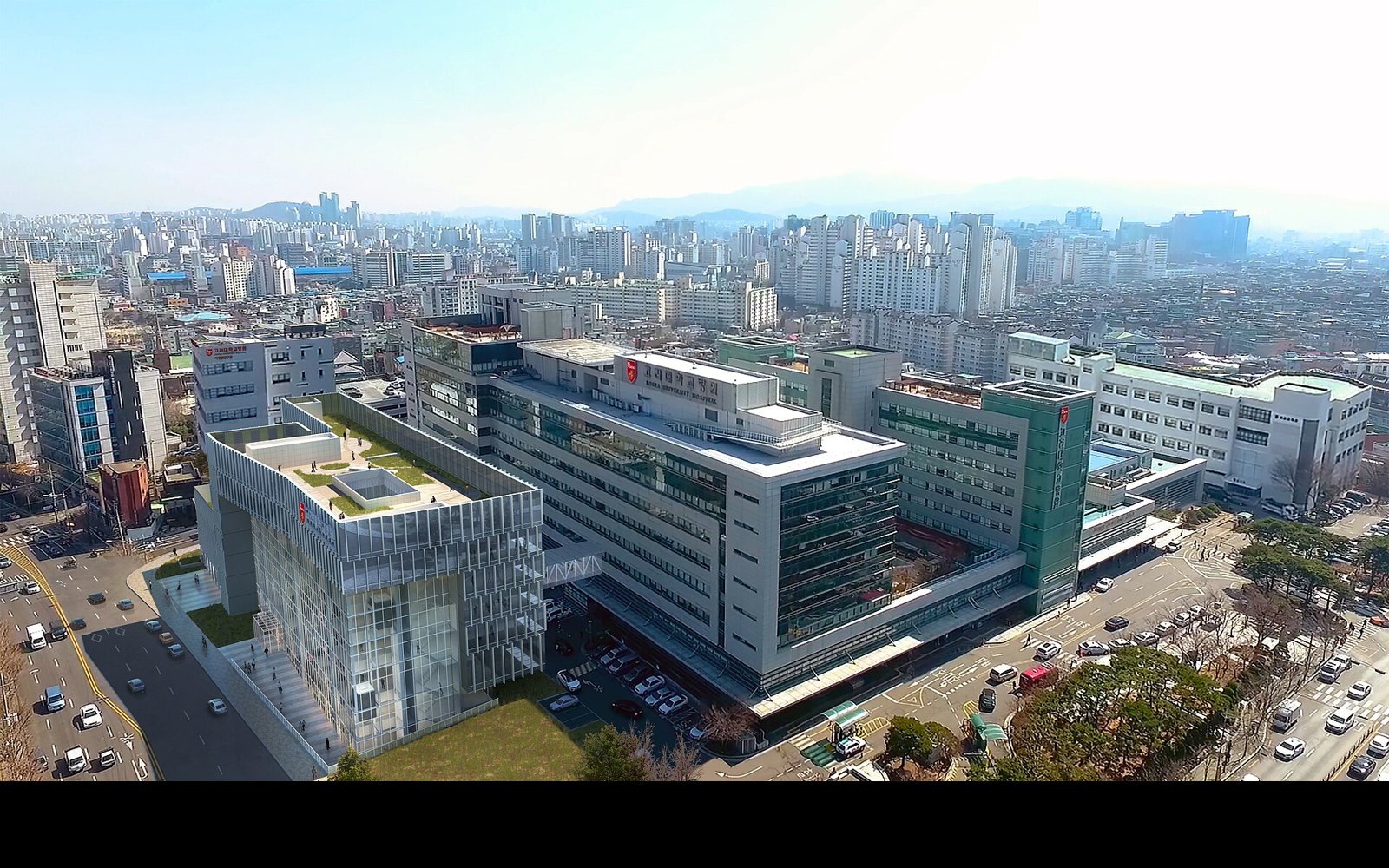

Open Lab, Korea University Guro Hospital
Research lab · R&D and clinical advice
Photo: Korea University Medicine PR Manager, CC BY-SA 4.0, Wikimedia Commons
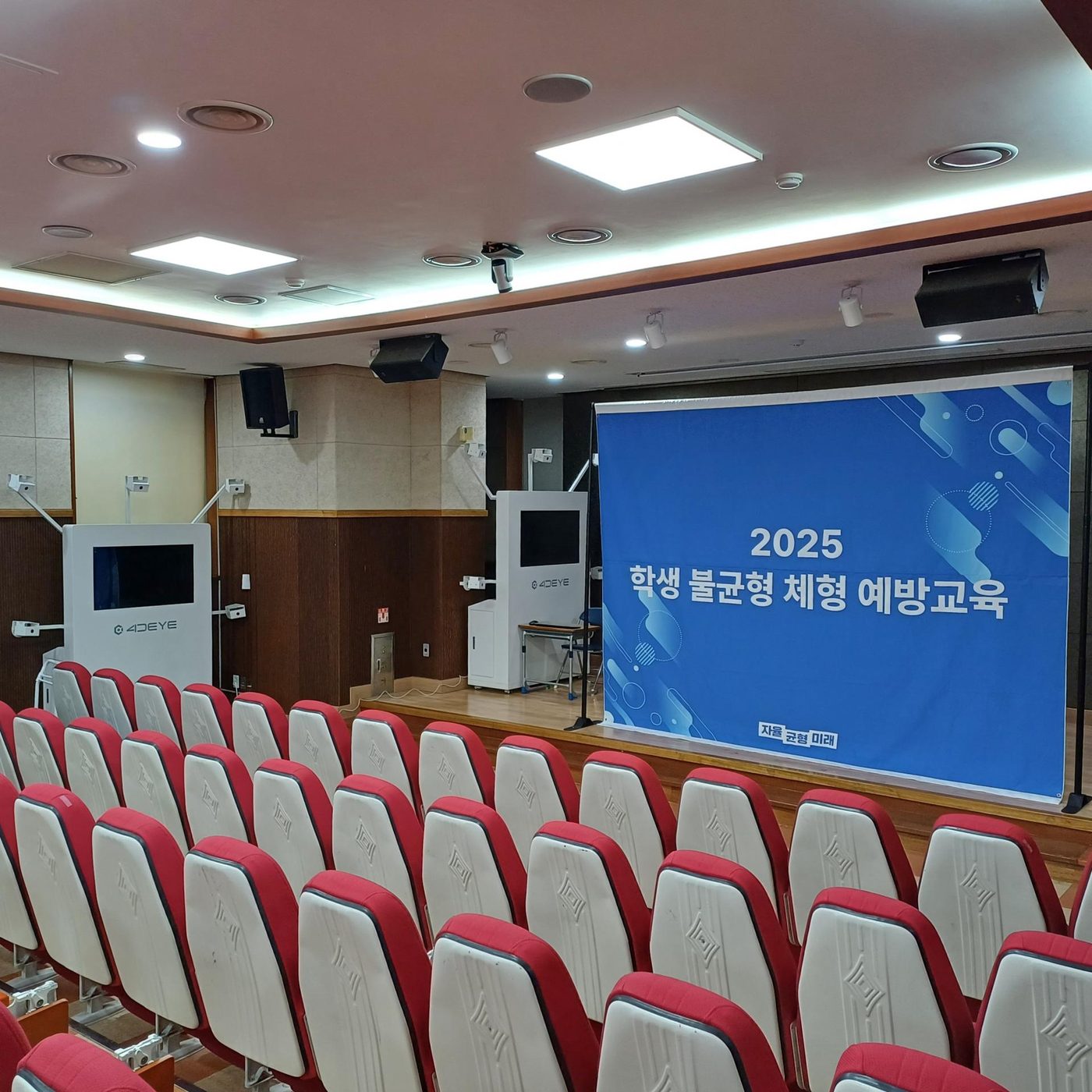

Gyeonggi Provincial Office of Education
2024–present · student postural imbalance programme
Photo: SYM Healthcare · student postural imbalance prevention class
Show patients the movement they can’t see
See a live assessment, terms sized to your hospital, and a payback simulation.